



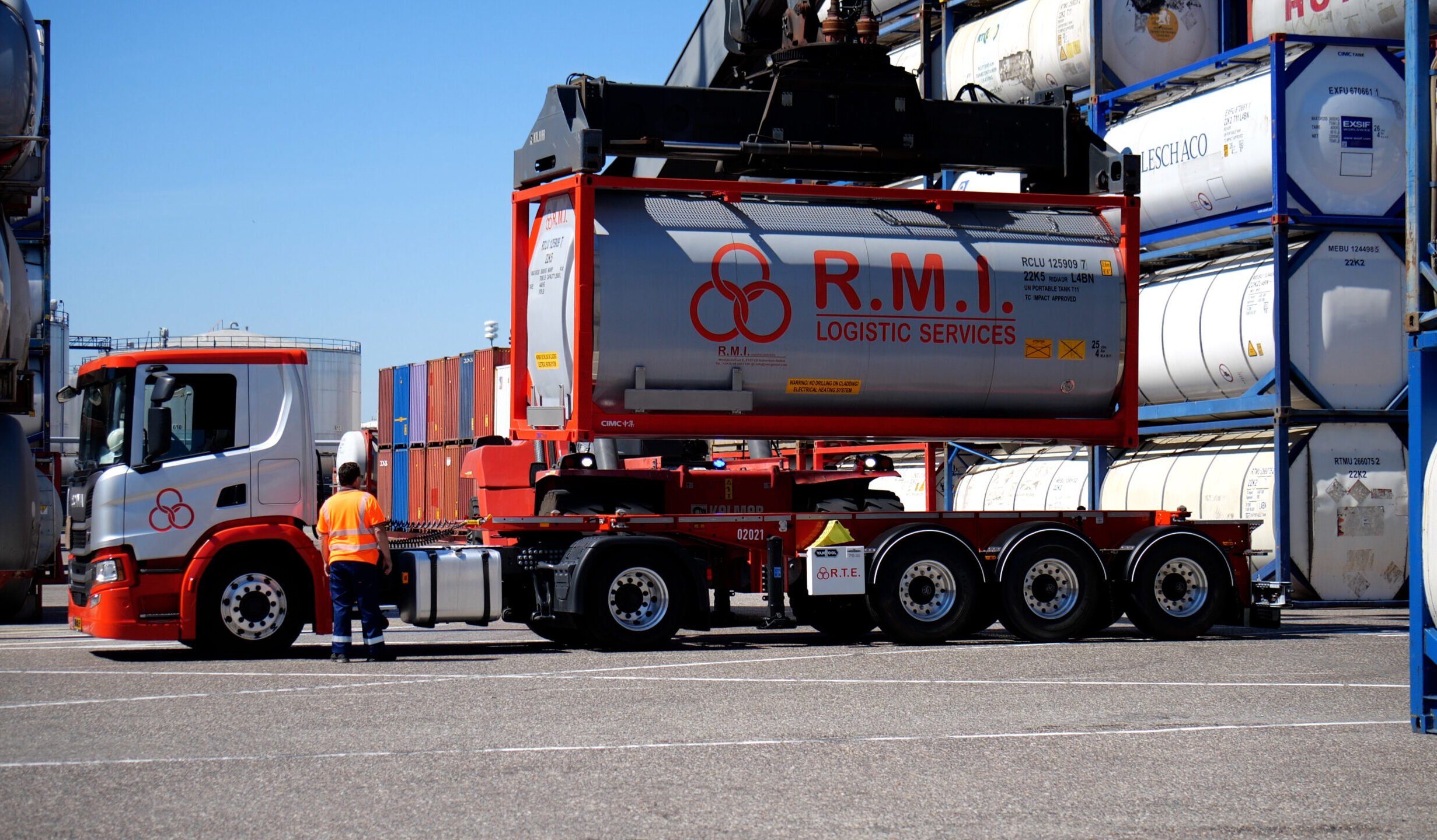
A forwarder has a liquid product that needs to be transported from Rotterdam to Northern Italy. Is it going to be done by road or is a combination of road and rail better? The answer is less straightforward than many people think. Three things weigh the most: how many tons you need to transport in one deal, how far the cargo needs to be transported and what product it is. In addition, two developments are increasingly weighing more heavily: the shortage of drivers in Europe and the pressure to reduce CO2 emissions. Below you can read how to make that calculation. We are happy to help you; the choice is yours.
What intermodal transport at RMI entails
In intermodal transport, you combine multiple modes in a single transport assignment. At RMI, these are rail, sea (shortsea and deepsea), and road. The road is only the first mile and the last mile: from the loading point to the train or ship, and from the terminal to the unloading point. The long section in between is by rail or sea.
Each tank container is a separate order with us. If you place an order for fifteen tanks, you will receive fifteen units each with their own booking. This gives us flexibility: often we spread the volume across multiple trains or ships, so one delay does not immediately affect your entire delivery.
Factor 1: tonnage and load capacity
The question is not how many containers you have, but how many tons you move in a single deal.
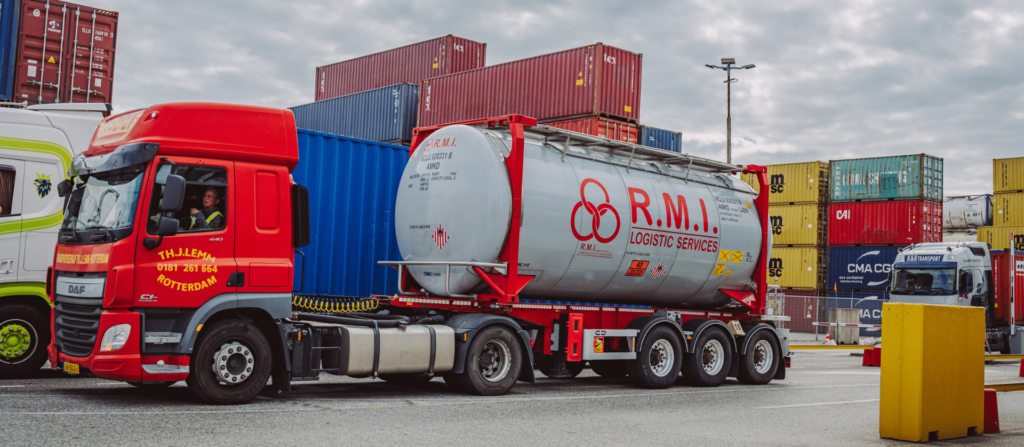
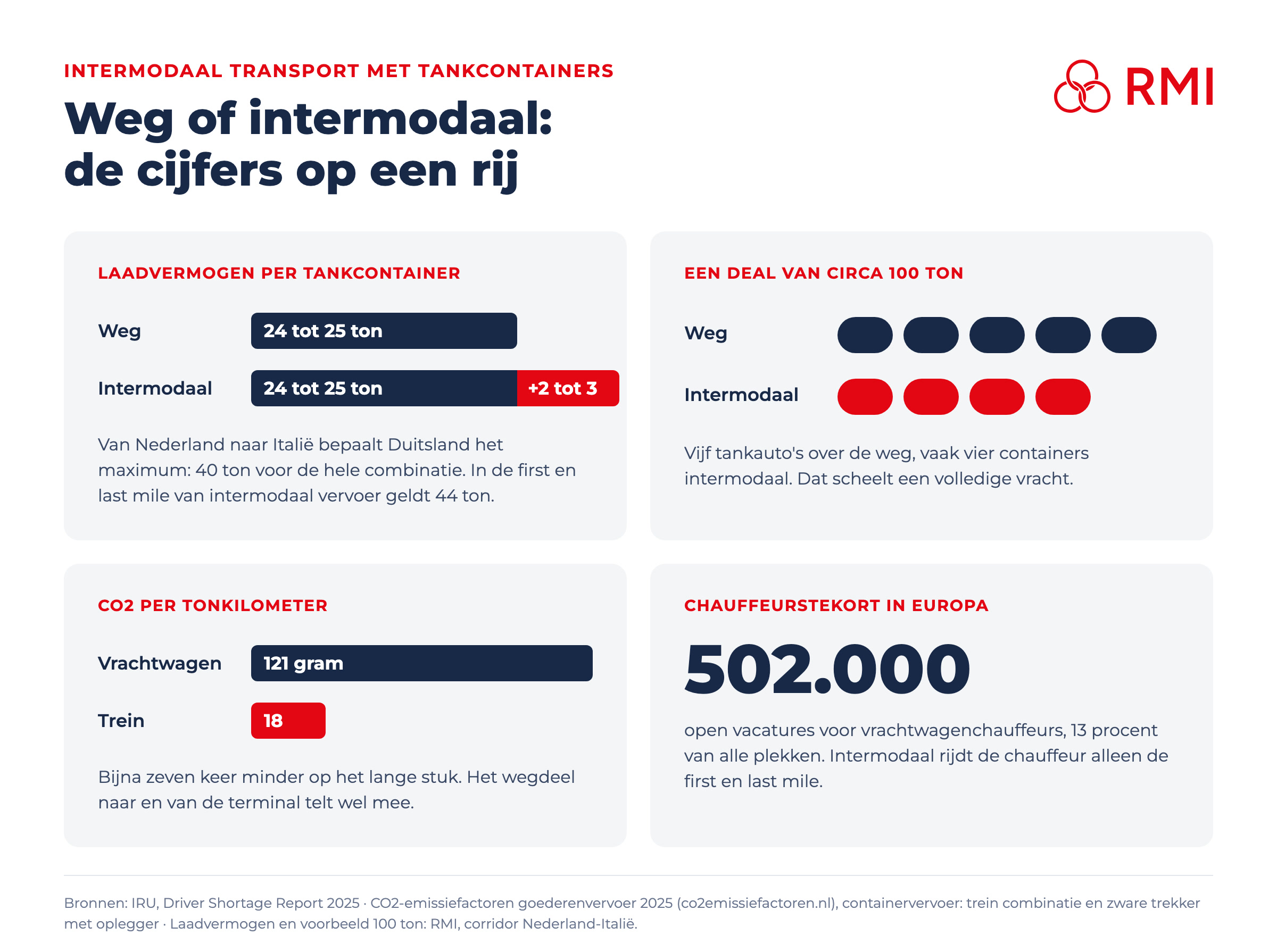
The maximum permissible weight on the road varies per country, and on a route the strictest country determines what you can load. Each corridor has its own restrictions. From the Netherlands to Italy that is Germany: there a combination on the road is allowed to weigh 40 tons. After deducting the tractor, chassis and tank, there remains about 24 to 25 tons for the product. In the pre- and inland transport of intermodal transport, a higher limit of 44 tons applies. This means that you can carry on average two to three tons more product per tank container.
With one shipment of 24 tons, that doesn’t make much difference. With a deal of 100, 150 or 200 tons, it does: you need fewer shipments. Where you would need five tank trucks on the road, you often get by with four containers through intermodal transport. That saves an entire load.
It works the other way too. Intermodal transport from the Netherlands to Northern Italy with a 25ft tank container costs the same, whether you load 24 or 27 tons into it. The more product you ship per container, the lower your transport price per ton.
Factor 2: distance
The longer the journey, the more attractive intermodality becomes. On the road, costs quickly add up with distance:
- Drivers must adhere to the driving and rest times and be able to take decent breaks on the road. That takes time and extra fees.
- The truck has to be returned, or be driven away from somewhere else.
- Toll fees are substantial on long routes.
- Every extra kilometer driven on the road means more CO2 emissions and more time spent in traffic jams.
At short distances, those points matter less. On a route like the Netherlands to Italy, Spain or Eastern Europe, they make the difference.
Factor 3: the product
Intermodal transport often takes a little longer than a direct road trip. For many products, this is not a problem. Oils, fats, most chemicals, and neutral products such as cleaning agents or vinegar have a long shelf life and can be transported for longer without any problems.
For other products, the situation is different:
- Products with a short shelf life need to be at their destination quickly.
- Temperature-sensitive products, which are loaded at 80 or 100 degrees Celsius and above, cool down on the way. Think of hot wax: it hardens and then needs to be heated for a long time before you can remove it.
If you have a product that lasts for a long time and is less sensitive to temperature, then intermodal is often worth considering. For some products, there are also tanks that keep the product at the correct temperature during transport. We will assess whether this works for your product and route on a case-by-case basis.
The shortage of drivers makes the road less secure
According to the international road transport organization IRU, there are about 502,000 vacancies for truck drivers in Europe, 13 percent of all positions (IRU research, 2025By 2030, approximately 660,500 drivers will retire. The shortage will therefore become larger rather than smaller.
For a logistics buyer, this means that capacity on the road is not a given, especially not on long international routes. You see it every year in the broken weeks of April and May, when shippers cannot get their cargo around to their regular carrier.
In intermodal transport, a driver only drives the short trips to and from the train or ship. The long journey takes place on the rail or at sea, where one train or ship carries dozens of containers at the same time. For the same tonnage, you therefore need much fewer driver hours. And because you load two to three tons more per container, you also need fewer trips.
CO2: where intermodality makes the difference
More and more shippers have to report or reduce their transport emissions, and sustainability is factored into tenders. According to the Dutch CO2 emission factors for freight transport (2025) A container train emits about 18 grams of CO2 per ton-kilometer. A heavy tractor-trailer carrying a container emits 121 grams. That is almost seven times as much.
The pre- and inland transport by road does count. The real difference therefore depends on the ratio between the short stretches of road and the long stretch of rail or sea. The longer the main route, the greater the profit. And the extra load capacity also helps here: fewer shipments for the same tonnage means less emissions.
The flexibility of a tank container
A tank container stands detached from the truck and fits on a chassis, a train car and a ship. This frees up space in your planning:
- The product remains in the same tank. The container travels from the road to the train or ship and back again, without the product being refilled.
- The container can wait; the driver can't. If it can't be unloaded for a moment, the tank container stays there and the truck drives on.
- You charge per unit. Because each container has its own booking, when there is a disruption or a change, you adjust one or a few units, not your entire delivery.
- For each product there is a tank. In addition to standard tank containers, there are versions for special products, such as rubber-lined tanks for aggressive chemicals and tanks that keep the product at a temperature. This also allows for transporting even difficult-to-handle products on trains or ships.
The trade-offs at a glance
| Factor | Intermodality becomes interesting when |
|---|---|
| Tonnage | Contracts of tens to hundreds of tons, so that it saves on the extra load capacity of shipments |
| Distance | Longer routes, where driving and rest times, tolls and empty runs count more heavily |
| Product | Products with a long shelf life and without strict temperature requirements |
| Capacity | Schemes where you want to be less dependent on available drivers |
| Sustainability | Shippers that have to reduce their CO2 emissions per ton or report them |
| Planning | Streams that you can plan ahead so that you can spread your volume across multiple rooms |
Why shippers choose RMI
RMI manages a fleet of approximately 1,500 tank containers from Rotterdam-Botlek. That is an organized fleet, and that is intentional. Our containers are constantly in motion and regularly return to our own depot. We keep track of each unit and know its condition.
We serve customers throughout Europe, even outside our regular corridors, for example in Romania, Bulgaria and the Baltic states. That is possible because we have been working with long-standing partners who load and unload for us for years. These relationships are more than just a client and supplier relationship. Partners invest for us in special equipment, hoses and sometimes fixed drivers, because they know that our work comes from us. Therefore, we rarely change partners, and you can see that by how carefully your product is handled.
Every shipment receives personal attention from the first booking to the final delivery.
Do you want to know if intermodal transport is suitable for your flows? Check out our Intermodal transport services, Read more about intermodal transport of chemicals or Please provide us with your volumes and routes. We make the comparison based on your own figures.
Frequently asked questions
From how many containers is intermodal transport profitable?
There is no fixed limit for this. Look at the number of tons you move in a single deal, the distance, and your product. With larger tonnages and longer distances, intermodal transport often results in fewer shipments and lower costs per ton.
How much more can I load in a tank container via intermodal transport?
On average, two to three tons more product than by road, depending on the route. The strictest country on the route determines what you can load on the road, and that varies per corridor.
Which products are suitable for intermodal transport?
Products with a long shelf life that are less sensitive to temperature, such as oils, fats, many chemicals and cleaning products. Products with a short shelf life or that need to remain warm will often be transported by road.
Does intermodal transport help to combat the shortage of drivers?
Yes. A driver only drives the first and last mile to and from the train or ship. The long part is done by rail or by sea. This means you need much fewer driver hours for the same tonnage.
How much CO2 do you save with intermodal transport?
It depends on the route. Per ton-kilometer, a container train emits almost seven times less CO2 than a truck with a container. The pre- and inland transport by road counts, so the longer the distance by rail or sea, the greater the savings.
Can I transport dangerous substances intermodally?
Yes, for most ADR classes. Which route is possible depends on the classification of your product. We look at this for each product and for each route.
How does RMI limit the risk of delays?
Each tank container is booked separately. For larger volumes, we spread the containers across multiple trains or ships, so a delay on one departure won’t affect your entire delivery.