


In chemical transport in a tank container, the choices revolve around four things: the tank type, the tank instruction (T-code) for your substance, the inspection dates on the tank, and what was previously in the tank. Those who pre-determine the four above will prevent a shipment from being left behind because the tank does not fit the product or because an inspection is carried out halfway through the chain. What RMI does in chemical transport can be read on the page Chemical Products. This article is about the tank itself: what types there are, how to read the codes and what to look out for during the inspection.
What types of tank containers are there for chemical transport?
In practice, you encounter two types of regulations, and they come from different sections of the legislation.
- UN portable tank: built in accordance with Chapter 6.7 of the ADR and the IMDG Code.
- ADR tank container: built in accordance with chapter 6.8 of the ADR, with its own tank code.
Some tanks have both approvals. Therefore, you should always look at the plate on the tank and not just at the volume or the type of frame. In intermodal transport, the regime varies per piece of the journey: on the road it is the ADR, on the rail the RID, and at sea the IMDG Code. That is also explained on our page. ADR transport.
The rules are maintained by the UN organization UNECE (ADR 2025, valid since January 1, 2025) and for the sea by the IMO. The IMDG Code 2024 (including Amendment 42-24) is mandatory since January 1, 2026.
This is how you read the T code and the tank code
Each hazardous substance has its own regulation in Table A of Chapter 3.2 of the ADR. It specifies which tank can be used for that substance. For a UN portable tank, that is a T-code, for example T11. That is the tank instruction: the requirements that the tank must meet for that substance, such as the minimum test pressure. For an ADR tank container, a tank code is given in the same place.
For you as the shipper, this means: the substance determines which tank is needed. Therefore, check the combination of the UN number and the tank instruction before you commit to a tank. If you do not yet know the UN number and the class, the conversation begins there. The data that we require as standard are listed on ADR transport.
Who needs to arrange things, such as the sender, the filler and the carrier, is mentioned in our article. ADR transport of bulk liquids: who regulates the shipper and who the carrier?. We deliberately leave that here.
Inspections: how long is a tank approved for?
The answer depends on the type. Often you hear “5 years”, but that’s not always the case. Here’s the overview by type:
| Type | Chapter | Periodic inspection | Interim inspection |
|---|---|---|---|
| UN portable tank | ADR and IMDG 6.7 | 5 years | 2.5 years |
| ADR tank container | ADR 6.8 | 5 years | 2.5 years |
| Fixed tank (tank truck) and removable tank | ADR 6.8 | 6 years | 3 years |
The 6 and 3 year periods apply to tanks that are permanently attached to a vehicle, not to tank containers. Sources: the technical directive of the International Tank Container Organisation (ITCO) for tank containers, and for fixed tanks the explanation provided by ADR.plus. Always check the dates on the plate for a specific tank, as the exact tolerance around the intermediate inspection varies by type.
Even those who carry out the inspection are bound by the law. According to the Inspectorate for the Environment and Transport (ILT), only approved companies are allowed to perform certain actions when transporting dangerous substances, such as the inspection and certification of tanks. See the page "Accredited bodies transporting dangerous substances".
What does this mean for your planning? Don’t just ask if the tank has been inspected; ask when the next inspection is due, and place that date alongside the entire transport chain. A tank whose inspection takes place in the middle of a long route is not a reliable choice for that shipment.
The previous batch and the cleaning
A tank container is not a disposable packaging. What was in it before counts for your product, and that applies in both directions. For your cargo: does a product with a different composition still fit in a tank that has previously transported something else? For the tank itself: according to the ADR, an empty tank container still falls under the rules as long as the tank has not been cleaned. Labels remain attached and a transport document is included.
In chemistry, this is not a formality at the end of the trip. When booking, ask what the cargo contained and what cleaning was done afterwards, and document this. For liquid food and feed, the ADR does not usually apply, but other requirements do apply, such as a cleaning certificate.
Special tanks: heated, coated or rubber-lined
Not every product fits into a standard tank. There are tanks that keep the product at a temperature and rubber-lined tanks for aggressive chemicals. A product that gets loaded hot, for example at 80 or 100 degrees, cools down along the way. The warm wax then solidifies and has to be heated for a long time before it can be removed. If your product needs a coating or heating, please let us know in advance. That is exactly the kind of special tank request that we ask the shipper for as standard. Whether it works for your product and route is assessed on a case-by-case basis.
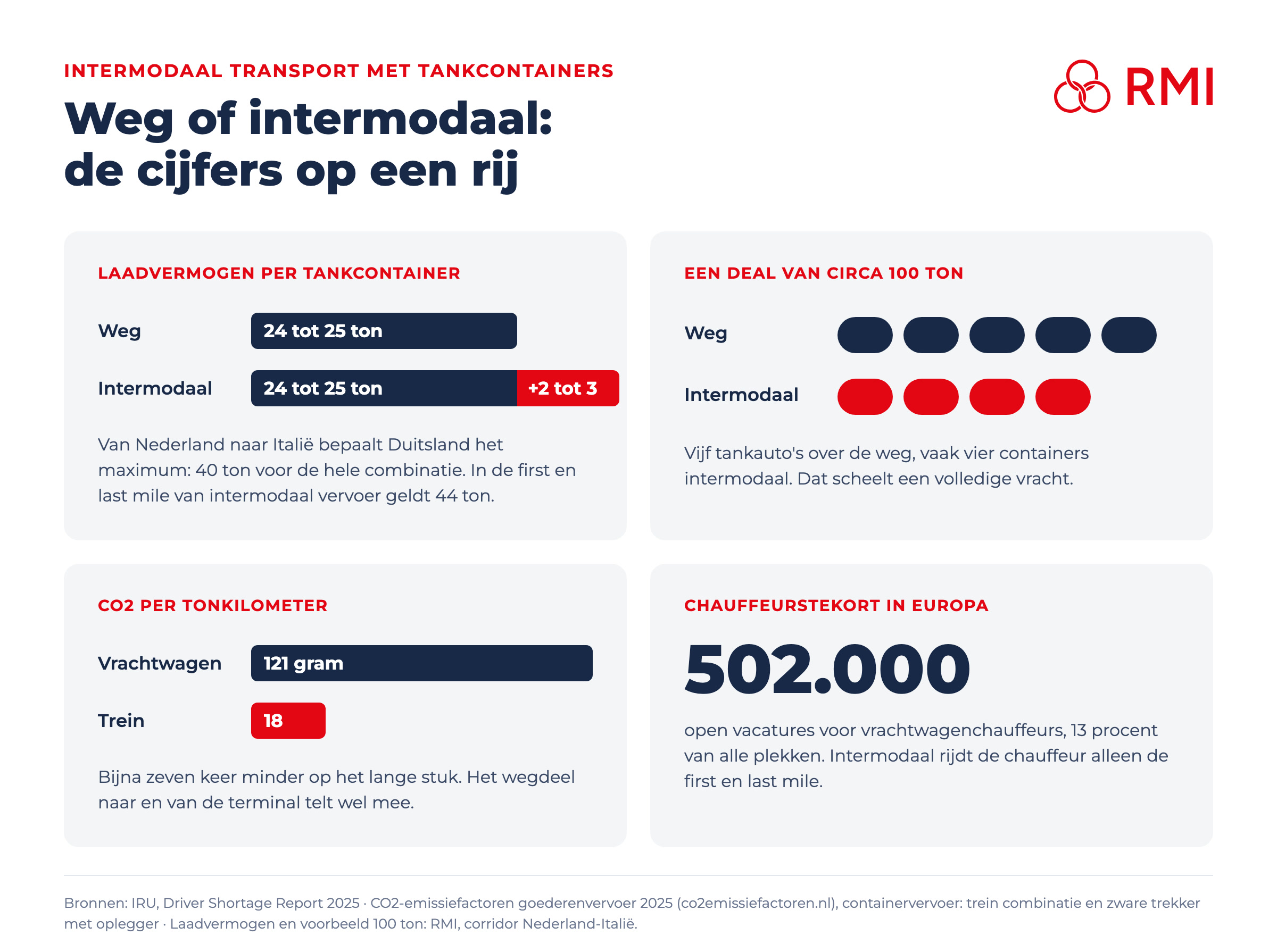
Whether intermodal transport is worth considering for your route can be read in Intermodal transport with tank containers: when is it worth it?. An overview of our approach can be found on Intermodal Transport.
Checklist for the conversation about the tank
- Tank type and approval: UN portable tank or ADR tank container, and for which modes of transport (road, rail, sea) the tank has been approved.
- Tank instructions for your fabric: the T-code or tank code that corresponds to your UN number, and whether the tank complies with it.
- Inspection dates: when do the periodic and interim inspections take place, and does one of them fall within your transport chain?
- Previous loading and cleaning: What was in it and how was the tank cleaned?
- Temperature and special requirements: charging and discharge temperature, heating, coating or rubber lining.
Frequently asked questions
What is the difference between a UN portable tank and an ADR tank container?
A UN portable tank is built according to Chapter 6.7 of the ADR and the IMDG Code. An ADR tank container follows Chapter 6.8 of the ADR. Which substances are allowed in it is determined by the T code or the tank code for that substance.
How often must a tank container be inspected?
A UN portable tank undergoes a periodic inspection after 5 years and an interim inspection after 2.5 years. According to ITCO, the same schedule applies to an ADR tank container. The 6 and 3 years apply to fixed tanks on a vehicle. Always check the dates on the tank itself.
Does an empty tank container still fall under the ADR?
Yes, as long as the tank has not been cleaned. The labels remain attached and a transport document is included.
What information do I need to choose a tank?
UN number, transport name, class and packaging group, the safety information sheet, the loading and unloading temperature and any special tank requirements such as coating or heating.
Planning a shipment?
Send us the product, its origin and destination, along with the UN number and the safety information sheet. We will look at which tank and route are suitable and what else we need from you. Contact us or ask for one directly Quote on.