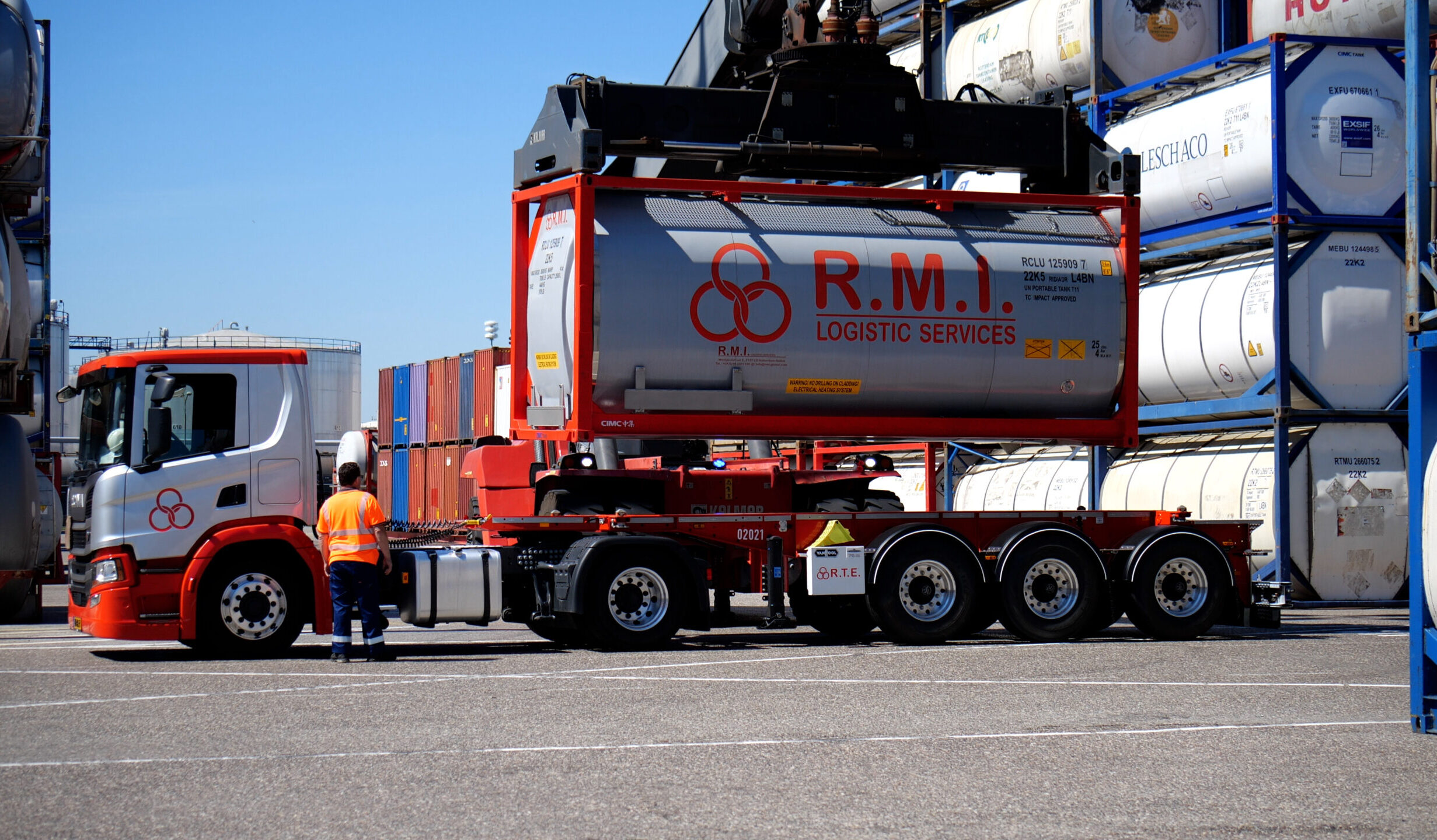




ADR transport of bulk liquids: who regulates the shipper and who the carrier?
A tank container is ready at the filling station. The product is a flammable liquid; tomorrow the container will be transported by road to the train heading for Northern Italy. Who checks that the tank is suitable, who applies the labels, and who ensures that the paperwork is correct? In ADR transport, this is not just a matter of agreement. The rules specify who is responsible for what, role by role.
In practice, this often gets mixed up. Below you can read how the tasks are divided when liquid bulk is transported in tank containers, and what you need to have ready before booking.
“The consignor” is not listed in the ADR
It ADR treaty regulates the transport of dangerous substances by road. In the Netherlands, the full text is set out in the Regulations on the transport by land of dangerous substances, and the Environmental and Transport Inspection keeps an eye on things.
You won't find the word "loader" in those regulations. The ADR looks at what you do, not who you are. For a tank container containing liquid, these are the factors that matter:
- Sender: the party that offers the shipment for transportation.
- Filler: the party that lets the product run in the tank.
- Tank container manager: the party that manages and approves the tank.
- Carrier: the party that carries out the transport.
- Receiver and liberator: the party that takes the product off and removes it from the tank.
One company can have multiple roles: a factory that fills and ships its own products is both a shipper and a filler. During an inspection, the inspector points out your own role, even if you have outsourced the work.
What the sender regulates
The sender starts the chain, and that is where most things go wrong. A mistake in the data travels the entire route.
- Organize the product properly. UN number, official transport name, class and packaging group. These details are usually already included in the safety data sheet.
- Provide the data for the transport document. Without proper organization, no correct document.
- Ask for a suitable tank. Not every tank is allowed to transport every product. The tank must be approved for your substance.
- Inform the carrier. Special requirements, such as a charging temperature or a product that needs to remain warm, must be discussed before booking.
What the filler regulates
In the case of bulk liquid, the filler plays a key role. It is here that the tank is last opened and closed, so this is also where the final checks take place.
- Check that the tank is in good condition and that the inspection date has not expired.
- Do not fill more than necessary for the product and the tank is allowed to be full.
- Close the valves and check that everything is leak-tight.
- Make sure there are no product residues on the outside of the tank.
- Apply the hazard labels and orange signs to the tank container.
What the carrier regulates
The carrier is responsible for the transport itself.
- Check whether the product can be transported and whether the documents are complete.
- Visual inspection of tank and vehicle: no leakage, no visible damage, inspection not completed.
- A driver with a valid ADR certificate, including the tank transport specialization.
- The written instructions for emergencies in the cabin, and the prescribed equipment on board.
- A route that suits the tunnel limitations of the product.
If the carrier detects a violation during that inspection, the shipment may not be allowed to depart according to the ADR until the problem is resolved.

Who controls what, in one overview
| Task | Sender | Filler | Tank container manager | Carrier |
|---|---|---|---|---|
| Product classification (UN number, class) | regulates | |||
| Data of transport document | regulates | checks whether the document is included | ||
| Tank suitable for the product | asks for it | controls | maintains admission | |
| Inspection and maintenance of the tank | checks the date | regulates | checks the date | |
| Filling rate and shut-off valves | regulates | |||
| Labels and orange signs on the tank | regulates | controls | ||
| Qualified driver and equipment | regulates | |||
| Route and tunnels | delivers tunnel code | regulates |
The overview also shows where things are going wrong: the tank. Three parties are looking at it, and each of them is looking at something different. That only works if the information gets around in time.
Intermodal: each mode has its own rules
Many bulk liquids do not travel all the way over the road. intermodal transport The truck only travels the first mile and the last mile, from the loading point to the train or ship and from the terminal to the unloading point. The long section in between is done by rail or by sea. Different rules apply for each route: the ADR for road transport, the RID for rail transport and the IMDG Code for shipping.
The structure of your product remains the same, but documents and registrations differ. See also the ILT page about dangerous substances per rail. Or whether intermodality is worth it for your electricity, you can read in road or intermodal: this is how to make the decision.
And with food and feed?
Liquid food products and feedstuff They are usually not dangerous substances. Then the ADR does not apply, but other requirements do. Think of requirements regarding the previous load and a cleaning certificate, often the latter. EFTCO Cleaning Document.
What you have ready before booking
This requires a carrier to choose the right tank and route:
- UN number, shipping name, class and packaging group, or the confirmation that the product is not subject to the ADR.
- The safety information sheet.
- Charging and melting temperatures, and whether the product needs to remain warm during transportation.
- The fill and release address, including loading times and any requirements of the location.
- Special requirements for the tank, such as a rubber-lined inner wall for aggressive chemicals or a tank that keeps the product at a temperature.
How we approach this
We transport liquid products in tank containers throughout Europe: chemicals, Dangerous (ADR) and non-dangerous, and in addition liquid food and feed. Our operation complies with the ADR regulations, and as an SQAS-evaluated company we participate in Responsible Care. The certificates can be found on the page Security and compliance.
In our role as tank container manager, we operate a manageable fleet of approximately 1,500 tank containers. These are constantly on the move and regularly return to our own depot, so we can see each unit on return and know its condition. Using your product data, we choose the tank and route that best suit your needs. We work together to provide you with the best solution. The choice is yours.
Want to know what this means for your product and route? See how we transporting chemical products and ours Intermodal transport services, Or provide us with your product details.
Frequently asked questions
What is ADR transport? ADR transport is the transport of dangerous substances by road under the European ADR Convention. The convention sets out how substances are classified, which tank or packaging is used, which documents are required and what requirements apply to the vehicle and driver. In the Netherlands, ADR is included in the Regulations on the transport by land of dangerous substances.
Who is responsible for ADR transport, the shipper or the carrier? Both, each for their own part. The ADR divides the responsibilities among roles such as dispatcher, filler, carrier and receiver. The dispatcher ensures proper classification and the data for the transport document, the filler for a properly filled and sealed tank, the carrier for the driver, vehicle and route.
Does the ADR also apply to the rail and sea sectors? No, the ADR applies to the road. For the rail sector, the RID applies, and for sea transport, the IMDG Code applies. In intermodal transport, the first and last mile on the road falls under the ADR, and the long distance section under the rules of the rail or sea sector.
Does an empty tank container still fall under the ADR? Yes, as long as the tank is not cleaned, it generally falls under the same rules as a full tank. The labels remain in place and a transport document is included. Only after cleaning does that expire.
Do I need a safety advisor as a shipper? Usually, yes. Companies that ship, fill, load, transport or unload dangerous substances must in principle appoint a safety advisor. Exceptions apply for small quantities. If you are unsure, ask the ILT or your own advisor.